
Email marketing tools often look similar when you first compare them. Most promise automation, templates, segmentation, and better engagement. But once a business starts sending regularly, building workflows, and trying to measure performance, the differences become much easier to see.
Brevo is still a popular option because it combines email, SMS, and basic CRM features in one platform, which makes it attractive for small businesses that want to get started quickly. But many users begin looking elsewhere when they need deeper automation, better segmentation, stronger reporting, or more control over delivery and infrastructure.
That is the real point of this guide. It is not just to list tools. It is to help you understand which Brevo alternative makes sense for your business model, growth stage, and technical setup.
Quick answer
The best Brevo alternatives for most businesses are MailerLite, ActiveCampaign, Mailchimp, GetResponse, HubSpot, Klaviyo, Moosend, SendGrid, and NextCRM. The right choice depends on what you need most. Some are better for simplicity. Some are better for advanced automation. Some are better for eCommerce. And some take a different approach by combining automation, delivery, and data control in one system.
What Is Brevo and Why Look for Alternatives?
Brevo is an email marketing platform that also includes SMS marketing and some CRM functionality. That combination makes it appealing for businesses that want more than just newsletter sending, but do not want to start with a heavy enterprise platform.
In practice, Brevo works best when your email setup is still fairly straightforward. You want to send campaigns, build simple automations, manage contacts, and keep costs under control in the early stage.
The issue usually appears later.
As campaigns become more advanced, teams often start to notice a few friction points:
- automation feels too basic for more complex lifecycle journeys
- pricing becomes harder to justify as usage grows
- segmentation can feel too broad for behavior-driven targeting
- reporting often tells you what happened, but not what it meant
- delivery and infrastructure control may still require additional tools or workarounds
That matters because email is still one of the highest-performing marketing channels. Email marketing is often cited as generating around $36 for every $1 spent, which raises the bar for what teams expect from their software. If a platform cannot help you connect engagement to outcomes, it starts to feel limited faster.
Best Brevo Alternatives at a Glance
| Tool | Best for | Automation | Hosting type | Overall fit |
| MailerLite | Simplicity and beginner-friendly email marketing | Medium | SaaS | Great for smaller teams |
| ActiveCampaign | Advanced automation and lifecycle marketing | High | SaaS | Strong for growing businesses |
| Mailchimp | Ease of use and broad familiarity | Medium | SaaS | Good for general use |
| GetResponse | Campaign-focused marketing teams | Medium | SaaS | Good all-in-one option |
| HubSpot | CRM-heavy businesses | High | SaaS | Strong but expensive |
| Klaviyo | eCommerce brands | High | SaaS | Excellent for stores |
| Moosend | Budget-conscious teams | Medium | SaaS | Good value option |
| SendGrid | Developers and transactional email | Low | SaaS | Infrastructure-first |
| NextCRM | WordPress users who want more control | High | Self-hosted | Unified system approach |
What to Look for in a Brevo Alternative
Automation depth
Many tools say they offer automation. That does not mean they offer the same type of automation.
Some platforms handle only simple sequences well. Others let you build customer journeys based on behavior, timing, engagement, purchase activity, and tags. The difference shows up quickly when your business moves beyond welcome emails and basic follow-ups.
Segmentation quality
Basic segmentation is about lists. Better segmentation is about behavior.
If you want to send more relevant campaigns, you need a platform that can group people based on engagement, activity, purchase history, or evolving contact data, not just static categories.
Reporting that helps you decide
A lot of email tools still lean heavily on open rates and click rates. Those metrics are useful, but they are not enough on their own.
The better alternatives help you understand which campaigns are working, which audiences respond best, and where performance is improving or breaking down.
Deliverability and infrastructure
This is the part many buyers underestimate.
Some tools make sending easy, but keep the infrastructure abstract. Others give you more direct control. As lists grow and campaigns become more important, this difference matters more.
Ownership and flexibility
SaaS tools are convenient. Self-hosted tools can offer more control.
That tradeoff becomes especially important for businesses that care about owning their setup, reducing tool sprawl, or keeping everything closer to their existing WordPress workflow.
9 Best Brevo Alternatives (Detailed Comparison)
1. MailerLite
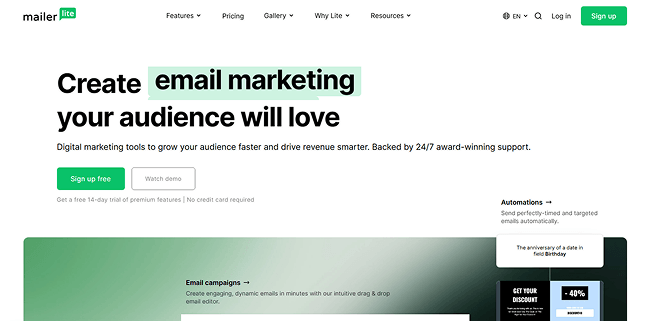
MailerLite is one of the most practical Brevo alternatives for small businesses, creators, and lean teams that want email marketing without extra complexity. It is easy to understand, easy to operate, and often easier to maintain day to day than tools that pack in more features but also more friction.
In real use, MailerLite works well when your priority is speed and clarity. If your team wants to create campaigns, build simple automations, collect subscribers, and avoid a cluttered interface, it does that very well. Its free plan is also one of the clearer entry points in this category, with support for up to 500 subscribers and access to core features like campaigns, automations, and landing pages.
Key features
- drag-and-drop email builder
- automation workflows
- landing pages and forms
- subscriber tagging and basic segmentation
Pros
- very easy to use
- clean interface
- strong free entry point for smaller lists
Cons
- less depth than more advanced automation platforms
- not the best fit for highly complex lifecycle campaigns
Best for
Small businesses, creators, and teams that want simplicity first.
2. ActiveCampaign
ActiveCampaign is one of the strongest Brevo alternatives for businesses that treat email automation as a serious growth function. It is built for deeper customer journeys, more detailed segmentation, and behavior-driven workflows that go well beyond basic autoresponders.
In practice, this is the kind of platform you choose when simple campaigns stop being enough. It can be more demanding to learn than Brevo or MailerLite, but that tradeoff is often worth it for teams that need more flexibility. ActiveCampaign also positions itself around automation, integrations, and AI-assisted workflows, with pricing that starts from an entry paid tier rather than a free forever plan.
Key features
- advanced automation builder
- behavior-based workflows
- CRM and pipeline support
- segmentation and personalization
Pros
- excellent automation depth
- strong lifecycle marketing capabilities
- good fit for scaling teams
Cons
- steeper learning curve
- cost can increase as your setup grows
Best for
Businesses that need advanced automation and customer journey control.
3. Mailchimp

Mailchimp remains one of the most recognized names in email marketing, and that still gives it an advantage for teams that value familiarity, ease of onboarding, and a wide ecosystem. It is often the platform people compare against Brevo because both serve a broad general market, especially among smaller businesses.
The main difference is how each one feels as you grow. Mailchimp is polished and easy to start with, but its free plan is more limited than it used to be, with a cap of 250 contacts and up to 500 sends per month on the free tier. That makes it less generous as a starting point than some alternatives, even if the interface remains approachable.
Key features
- campaign builder
- templates and design tools
- audience management
- basic automations
Pros
- beginner-friendly
- strong brand familiarity
- broad integrations
Cons
- limited free plan
- pricing can become restrictive at scale
Best for
Businesses that want a familiar and easy-to-use email platform.
4. GetResponse
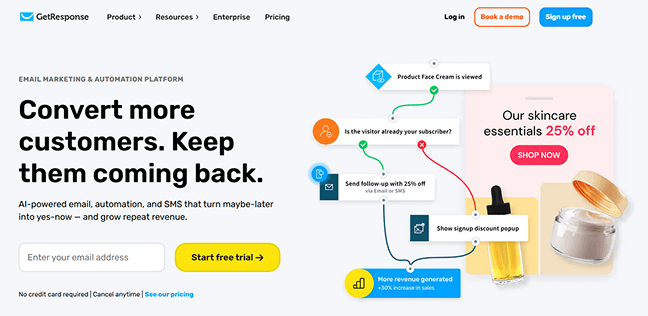
GetResponse is a broader marketing platform than Brevo in some areas because it combines email marketing with funnels, landing pages, and webinars. That makes it attractive for marketers who want to run campaign systems from one place rather than bolting together separate tools for lead generation and follow-up.
Its value depends on how you market. If you mostly need email campaigns and basic automation, it may feel like more platform than necessary. But if your strategy depends on webinars, lead magnets, and funnel-style campaigns, GetResponse can be a more natural fit than Brevo.
Key features
- email automation
- funnel builder
- landing pages
- webinar support
Pros
- broader campaign toolkit
- useful for structured marketing funnels
- stronger than basic newsletter tools for lead generation
Cons
- interface can feel busy
- not as focused as specialist email tools
Best for
Marketing teams that want email plus funnel and campaign tools.
5. HubSpot
HubSpot is not just an email marketing platform. It is a much wider CRM and growth ecosystem. That makes it one of the most powerful options in this list, but also one of the least comparable to Brevo in terms of cost and complexity.
For businesses with established sales and marketing processes, HubSpot can bring valuable alignment between email, CRM, pipeline activity, and reporting. For smaller teams, it can feel too heavy. It is best understood as a business system that includes email marketing, not an email platform that later added CRM.
Key features
- CRM and contact management
- email automation
- reporting and analytics
- sales workflow support
Pros
- very strong CRM alignment
- useful for cross-team visibility
- broad business functionality
Cons
- expensive compared with simpler tools
- too much platform for many smaller businesses
Best for
Mid-sized and larger teams that need email tied closely to CRM and sales activity.
6. Klaviyo
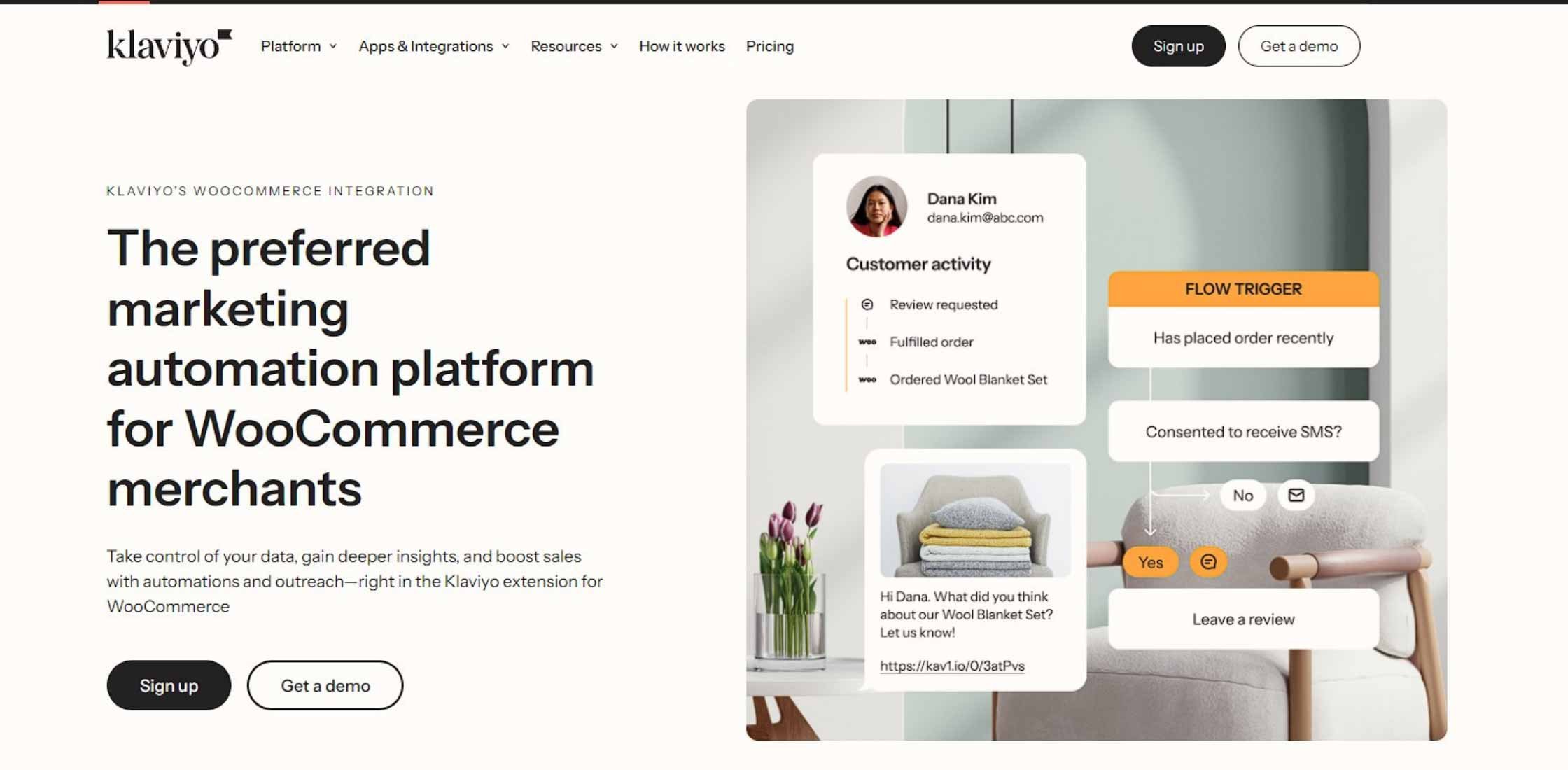
Klaviyo is one of the strongest Brevo alternatives for eCommerce brands because it is built around customer behavior, purchase data, and retention marketing. If your business depends on repeat purchase flows, abandoned cart recovery, product recommendations, or customer lifecycle segmentation, Klaviyo tends to feel much more purpose-built than general email tools.
That strength does come with a pricing tradeoff. For stores that are actively growing, Klaviyo can still be worth it because of how tightly it supports revenue-focused automation. For businesses outside eCommerce, its specialization can be less compelling.
Key features
- eCommerce segmentation
- customer behavior tracking
- email and SMS campaigns
- retention and lifecycle flows
Pros
- excellent for online stores
- strong data-driven targeting
- built for purchase and retention workflows
Cons
- pricing grows with list size and use
- less attractive for non-eCommerce brands
Best for
eCommerce businesses that rely on customer data and retention campaigns.
7. Moosend
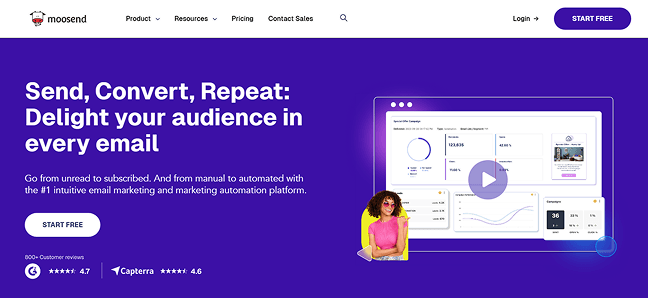
Moosend is a value-focused alternative for businesses that want core automation and campaign tools without moving into enterprise-level pricing. It occupies a useful middle space where the interface is manageable, the pricing stays more accessible, and the platform still covers the essentials for many small teams.
It is not the most advanced tool in this list, but it often does enough for businesses that want dependable email marketing without paying for features they are unlikely to use.
Key features
- campaign builder
- automation workflows
- templates and reporting
- list management
Pros
- affordable
- straightforward setup
- good fit for smaller teams
Cons
- less advanced than top-tier automation platforms
- smaller ecosystem than bigger brands
Best for
Small businesses that want good value and solid core functionality.
8. SendGrid
SendGrid is different from most of the alternatives here because it is more focused on delivery infrastructure than on full marketing automation. That makes it a strong fit for developers, SaaS products, and businesses that care more about transactional email and API-based sending than campaign building.
If your main need is newsletters, segmentation, and lifecycle marketing, SendGrid is usually not the cleanest replacement for Brevo. If your main need is reliable delivery infrastructure, it becomes much more relevant.
Key features
- email API
- transactional email sending
- delivery tools and analytics
- developer-focused setup
Pros
- strong deliverability reputation
- good fit for technical teams
- useful for product and application email
Cons
- not ideal for non-technical marketers
- weaker as a full marketing platform
Best for
Developers, SaaS companies, and infrastructure-focused email use cases.
9. NextCRM
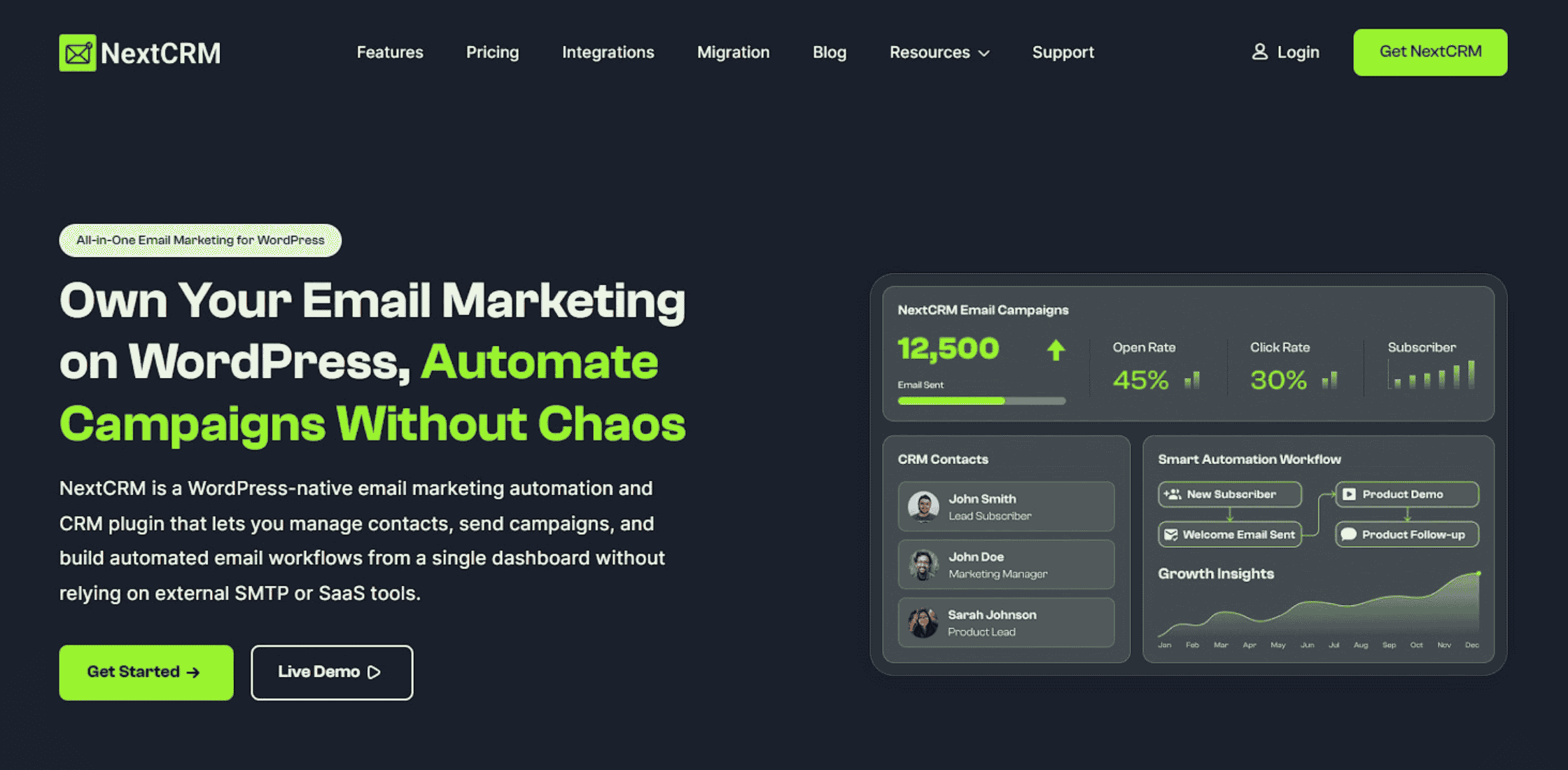
NextCRM takes a different position from most Brevo alternatives because it is not trying to be another generic SaaS email platform. It is a self-hosted, WordPress-native system built around email automation, delivery control, behavioral segmentation, and campaign visibility inside one environment.
That matters in practice because many businesses eventually end up stitching together separate tools for contacts, automation, and sending. NextCRM is built to reduce that fragmentation. It includes a native delivery infrastructure with multi-mailbox support, behavior-driven automation, and a WordPress-based setup that gives businesses more control over data and operations instead of pushing them further into third-party dependence.
Key features
- WordPress-native email automation
- built-in delivery infrastructure
- behavior-based segmentation
- campaign-to-revenue visibility
- self-hosted control over data and setup
Pros
- no separate SMTP plugin requirement
- stronger control over infrastructure and data
- unified setup inside WordPress
- clearer fit for businesses that want ownership
Cons
- best suited to WordPress users
- not the right fit for teams that want pure SaaS convenience
Best for
WordPress-based businesses that want more control over automation, delivery, and customer data in one system.
Brevo vs Alternatives: What Actually Changes
Brevo vs MailerLite
MailerLite is the better fit when simplicity matters most. Brevo offers a broader feature set, but MailerLite often feels easier to manage in daily use.
Brevo vs ActiveCampaign
ActiveCampaign is the stronger option when automation depth is the priority. Brevo handles simpler flows well, while ActiveCampaign is better for more advanced customer journeys.
Brevo vs Mailchimp
Mailchimp is usually chosen for usability and familiarity. Brevo may look more attractive from a cost perspective early on, but Mailchimp still appeals to teams that want a polished, familiar workflow.
Brevo vs GetResponse
GetResponse is better for campaign-heavy marketers who want funnels, webinars, and landing pages in one place. Brevo is simpler, but less flexible in that broader campaign sense.
Brevo vs HubSpot
HubSpot is more of a full business platform than a direct Brevo replacement. It is stronger for CRM-heavy teams, but much heavier and more expensive.
Brevo vs Klaviyo
Klaviyo is the better choice for eCommerce. If retention marketing, customer data, and revenue-driven flows matter most, it usually offers more depth than Brevo.
Brevo vs Moosend
Moosend is a practical budget alternative. It gives smaller teams a simpler way to run email marketing without stretching costs too far.
Brevo vs SendGrid
This is really a use-case comparison. Brevo is better for marketing teams. SendGrid is better for developers and transactional email infrastructure.
Brevo vs NextCRM
Brevo is a SaaS platform built for accessibility and convenience. NextCRM is a stronger fit for WordPress businesses that want a more unified setup with self-hosted control, built-in delivery infrastructure, and behavior-driven automation instead of relying on separate third-party tools. That makes it a more compelling Brevo alternative for teams that care about ownership, flexibility, and long-term control.
A Different Approach to Email Automation
Why Most Tools Feel Limited Over Time
As campaigns grow, many businesses end up using multiple tools:
- CRM for contacts
- SMTP for delivery
- automation platform for workflows
This creates fragmentation. Data becomes disconnected, and performance becomes harder to track.
From practical experience, this is where many email setups begin to feel inefficient. Teams stop spending time improving campaigns and start spending more time managing tools.
A More Unified System
While most Brevo alternatives rely on SaaS-based platforms, some systems take a different approach. NextCRM runs as a self-hosted solution inside WordPress, allowing businesses to control their email automation, data, and delivery from one place. This removes the need for external SMTP tools and reduces dependency on third-party services.
That shift matters more than it sounds. For businesses already operating inside WordPress, a unified system can reduce tool sprawl and make campaign management easier to control over time.
Practical use case
A WooCommerce store owner managing thousands of customers often needs:
- behavior-based segmentation
- controlled email delivery
- campaign performance tracking
Managing this across multiple tools increases complexity. A unified system simplifies the workflow and improves visibility.
SaaS vs Self-Hosted Email Marketing
| Feature | SaaS tools | Self-hosted setup |
| Convenience | High | Medium |
| Control over infrastructure | Limited | High |
| Data ownership | Lower | Higher |
| Tool dependency | Higher | Lower |
| WordPress alignment | Usually external | Native if built for WordPress |
For many businesses, SaaS is still the right choice because it is easy to adopt.
But if you are already operating inside WordPress and care about ownership, infrastructure control, and reducing tool fragmentation, a self-hosted system becomes much more attractive over time.
When Should You Switch from Brevo?
You should consider switching from Brevo when one or more of these issues starts to affect your workflow:
- your automation needs become more advanced than the platform feels comfortable handling
- your reporting tells you engagement numbers, but not enough about outcomes
- your costs rise faster than the value you are getting back
- your setup depends on too many separate tools
- you want more control over delivery, segmentation, or infrastructure
The key sign is not just frustration. It is when your current setup starts slowing down better marketing decisions.
FAQ
What is the best Brevo alternative?
There is no single best option for everyone. MailerLite is strong for simplicity. ActiveCampaign is strong for advanced automation.
Klaviyo is strong for eCommerce. NextCRM is a strong fit for WordPress businesses that want more control over automation and delivery.
Which Brevo alternative is best for automation?
ActiveCampaign is one of the strongest options if your main priority is advanced automation. NextCRM is also worth considering if you want automation combined with WordPress-native control and built-in delivery infrastructure.
Which Brevo alternative is best for WordPress users?
NextCRM is the strongest fit in this list for WordPress users because it is self-hosted and runs inside the WordPress environment rather than outside it.
Which Brevo alternative is cheapest?
For many smaller teams, MailerLite and Moosend are among the more budget-friendly options. MailerLite’s free plan supports up to 500 subscribers, which makes it especially attractive as an entry point. (MailerLite)
Is SendGrid a direct replacement for Brevo?
Not really for most marketers. SendGrid is much stronger for developers and transactional email use cases than for general email marketing workflows.
Final Thoughts
Brevo is still a reasonable choice for businesses that want a simple all-in-one starting point.
But once your email strategy becomes more serious, the differences between platforms get harder to ignore. Some tools are better for simplicity. Some are better for automation. Some are better for eCommerce. And some, like NextCRM, make more sense when the real goal is not just sending campaigns but gaining more control over automation, delivery, and data in one place.
That is the real decision to make.
You are not just choosing a feature list. You are choosing the type of system you want your business to rely on as email grows more important.