TL;DR: Effective Black Friday marketing strategies connect your offer, audience, timing, channels, checkout experience, and follow-up into one coordinated campaign. Start with an offer your margins can support, decide who should receive each message, keep promotions consistent across channels, stop irrelevant messages after purchase, and measure contribution instead of judging success by revenue alone.
Black Friday can bring a rush of traffic and orders, but bigger discounts, more emails, and higher ad spending do not automatically create a more profitable campaign. The harder work is deciding what your business can afford to offer, who should receive each promotion, when messaging should stop, and whether the additional sales still make sense after you account for the real costs.
The opportunity is substantial. U.S. shoppers spent $11.8 billion online on Black Friday in 2025, while Cyber Week generated $44.2 billion. Adobe’s latest 2026 forecast expects Black Friday online spending to reach $12.9 billion and Cyber Week to reach $47.5 billion in the U.S.
Instead of adding another long list of Black Friday marketing ideas, this guide uses a Black Friday Campaign Decision Framework built around five connected decisions.
Economics → Audience → Timing → Eligibility → Measurement
The best Black Friday marketing strategies balance customer value with margin, timing, audience relevance, and operational capacity, creating a campaign customers can understand and the business can actually support.
Black Friday Strategy at a Glance
| Decision | Question to answer | What to prepare |
| Economics | What can we afford to offer? | Margin, variable costs, stock |
| Audience | Who should receive the campaign? | Buyer, nonbuyer, VIP, cart and late-subscriber groups |
| Timing | When should each message appear? | Launch, reminder, deadline and Cyber Monday plan |
| Eligibility | Who should stop receiving a message? | Purchase, unsubscribe, expiry and overlap rules |
| Measurement | Did the campaign create enough value? | Paid orders, refunds, contribution and repeat purchases |
Use this table as the campaign’s decision sheet. If one part changes, check whether the other four still make sense.
1. Build Your Black Friday Marketing Strategies Around One Goal
A strong Black Friday marketing strategy starts with one primary business goal and the constraints that could stop you from reaching it.
“Generate more sales” is too broad to guide useful decisions. A store trying to clear seasonal inventory should not automatically use the same campaign as a business trying to acquire first-time customers, increase average order value, or encourage previous customers to return.
What should your Black Friday goal be?
Start with the business outcome you actually want.
| Primary goal | Main constraint | Useful strategy direction |
| Acquire new customers | Acquisition cost | Entry offer, bundle, strong first-purchase value |
| Increase order value | Margin and product mix | Bundles, thresholds, complementary products |
| Clear inventory | Available stock | Product-specific promotion |
| Reward existing customers | Customer relevance | Early access, exclusivity, loyalty value |
| Increase repeat purchases | Purchase timing | Relevant follow-up instead of another sitewide blast |
The goal gives the campaign direction. Your constraints decide how far you can push it.
What can your business realistically support?
Before adding more tactics, check the limits behind the campaign.
- How much margin can the offer give up?
- Is there enough stock for the demand you are trying to create?
- Can checkout handle more traffic?
- Can the team fulfill orders on time?
- Is your email audience ready for higher seasonal volume?
- Do you have enough time to test a new channel properly?
A smaller WooCommerce store should not copy a large retailer simply because its promotion looks impressive. The campaign has to fit the business behind it.
Practical takeaway: Choose the business goal first. Add tactics only when they support that goal without creating a larger operational problem.
2. Choose an Offer That Leaves Room for Costs
A Black Friday offer is viable only when customers receive meaningful value and the business still keeps enough contribution from each order.
Percentage discounts are easy to communicate, which is one reason they dominate Black Friday. However, effective Black Friday marketing strategies compare customer value with the contribution left after each sale instead of assuming the deepest discount is automatically the strongest offer.
Discount, bundle, or gift?
Use the offer type that matches your economics and your customers’ motivations.
| Offer type | Best when | Main risk |
| Discount | Price is a major buying barrier | Contribution can fall quickly |
| Bundle | Products naturally complement each other | Bundle may feel forced |
| Gift with purchase | Gift has high perceived value but manageable cost | Added packing or shipping cost |
| Free-shipping threshold | You want to increase order value | Shipping cost may absorb margin |
| Exclusive product | Scarcity or uniqueness matters | Requires real product interest |
| Early access | Loyal customers value priority | Weak if everyone gets the same access immediately |
This is a decision aid, not a ranking. The right choice depends on your product, margin, inventory, and audience.
Calculate contribution before choosing the discount
Consider a hypothetical brewing kit with a normal selling price of $100.
Assume the product costs $40, payment processing costs 3% of collected merchandise revenue, merchant-paid shipping costs $6, and the business allows $4 per order for expected returns and support.
| Offer scenario | Revenue | Product | Fee | Shipping | Returns/support | Gift | Contribution* |
| Full-price reference | $100 | $40 | $3.00 | $6 | $4 | $0 | $47.00 |
| 20% discount | $80 | $40 | $2.40 | $6 | $4 | $0 | $27.60 |
| Full price + $8 gift | $100 | $40 | $3.00 | $6 | $4 | $8 | $39.00 |
Contribution means collected merchandise revenue minus the variable costs shown here. It is not net profit.
Under these assumptions, the 20% discount needs about 1.70 times as many orders to match the contribution from one full-price order. The gift example needs roughly 1.21 times as many orders.
That does not prove the gift is better. Customers may respond more strongly to the discount, while the gift itself could add packing, shipping, or support costs. What the calculation does is expose the trade-off before launch.
How much should you discount for Black Friday?
There is no universal best percentage.
Adobe expects discounts across U.S. ecommerce to reach up to 30% off listed prices during Cyber Week in 2026, with peak discount levels varying by category. That describes the market, not the number your business should copy.
Use your own costs, inventory position, expected order volume, and customer behavior before choosing a percentage.
Can exclusivity work instead of a deeper discount?
Klaviyo reports that Jones Road Beauty has used limited-edition product drops during BFCM instead of relying only on traditional discounts.
The useful lesson is not to copy the product. It is to recognize that exclusivity can create a reason to buy without making price the only reason to act.
Practical takeaway: Do not ask, “What discount should we run?” until you have compared what each offer actually leaves behind.
3. Build Your Audience Around Customer State
Black Friday segmentation works best when customer behavior determines the message instead of forcing every contact through the same campaign.
A subscriber who purchased yesterday should not automatically receive the same promotion as someone who has never bought. Likewise, a cart visitor, a loyal customer, and someone who joined this morning may each need different messaging.
Which Black Friday audience segments actually matter?
For many ecommerce teams, these groups are enough.
| Customer state | Useful treatment | Important rule |
| Existing customer or VIP | Genuine early access | Exclude irrelevant recent purchases |
| Eligible nonbuyer | Launch and useful reminders | Stop acquisition messages after purchase |
| Late subscriber | Current offer and product context | Skip expired teasers |
| Cart or checkout visitor | Relevant recovery path | Check purchase and broadcast overlap |
| Recent buyer | Fulfillment and product guidance | Do not immediately resell the same item |
| Unsubscribed or complained | No marketing send | Eligibility overrides the calendar |
You do not need dozens of segments because the software allows them. A smaller number of groups that your team understands and verifies is more useful during a fast-moving campaign.
What should late subscribers receive?
Someone who joins after the sale has started should receive current information, not a compressed replay of everything they missed.
If early access ended two days ago, do not send the expired sequence just to complete an automation. Explain what is available now, why it may be relevant, and when the current offer ends.
For evergreen entry and exit logic, your email marketing funnel guide can carry the deeper explanation without duplicating it here.
4. Give Every Black Friday Email a Clear Job
Black Friday email marketing works better when every message has a clear purpose and a defined audience.
One of the most common BFCM questions is how many emails a business should send. Email can support effective Black Friday marketing strategies when each message reflects the customer’s current state, so there is no fixed send count that fits everyone.
How many Black Friday emails should you send?
Think about the job of each message rather than chasing a send count.
A campaign might include:
- early-access invitation
- public launch
- product or offer explanation
- objection-handling email
- cart or checkout reminder
- genuine deadline reminder
- post-purchase guidance
Not every customer needs every message.
Someone who buys after launch should move away from acquisition messaging. Someone joining on Cyber Monday does not need the previous week’s teaser.
What should you check before an important send?
A scheduled email can become irrelevant between the moment it is created and the moment it is sent.
Before an important campaign message leaves, confirm that the contact has not:
- purchased the promoted item
- unsubscribed
- complained
- entered a conflicting workflow
- become ineligible for the offer
Check the promotion too. Stock shortages, checkout problems, or an expired deadline can turn a previously correct message into the wrong one.
Is your email infrastructure ready?
Black Friday is a poor time to discover technical sending problems.
Google requires senders to personal Gmail accounts to meet requirements covering areas such as authentication and spam rates. Senders delivering more than 5,000 messages per day to Gmail accounts have additional requirements that include SPF, DKIM, DMARC, domain alignment, and one-click unsubscribe for relevant commercial messages.
Before volume rises, review:
- sender authentication
- unsubscribe behavior
- audience permission
- sender identity
- test messages
- destination links
- bounce and complaint handling
For broader setup guidance, readers can continue with the WordPress email marketing guide.
5. Coordinate Your Black Friday Marketing Strategies Across Channels
Black Friday channels should perform different jobs while communicating the same offer, terms, and deadline.
Email, social media, ads, creator content, and landing pages do not need identical copy. Customers should still receive the same core information wherever they encounter the campaign.
Create one source of truth
Record these campaign details in one place:
- eligible products
- promotional value
- start and end time
- timezone
- shipping terms
- coupon rules
- exclusions
- landing-page URL
- stock limits
- pause conditions
This reduces the chance that your email promises one thing while the product page or social post says something else.
Make product information easy to understand everywhere
Adobe expects traffic from AI-powered services to U.S. retail websites to rise 130% year over year during the 2026 holiday season. It also expects social media and affiliate or partner channels to gain revenue share.
The practical response is not to create a different strategy for every discovery channel. Keep the fundamentals clear wherever the shopper arrives.
Make sure customers can find:
- price and promotional terms
- product benefits
- availability
- useful images
- shipping expectations
- return information
- answers to common questions
Is your campaign mobile-ready?
Adobe forecasts that mobile devices will generate 57.4% of U.S. online holiday spending in 2026.
Test the campaign on a real phone and check whether the main offer appears quickly, popups stay out of the way, coupon fields work, forms are easy to complete, payment methods function, and shipping information is easy to find.
6. Remove Checkout and Fulfillment Friction Before Launch
A Black Friday campaign cannot compensate for a purchase experience that breaks when traffic increases.
Marketing preparation should include the complete path from promotional page to successful payment.
Black Friday pre-launch checklist
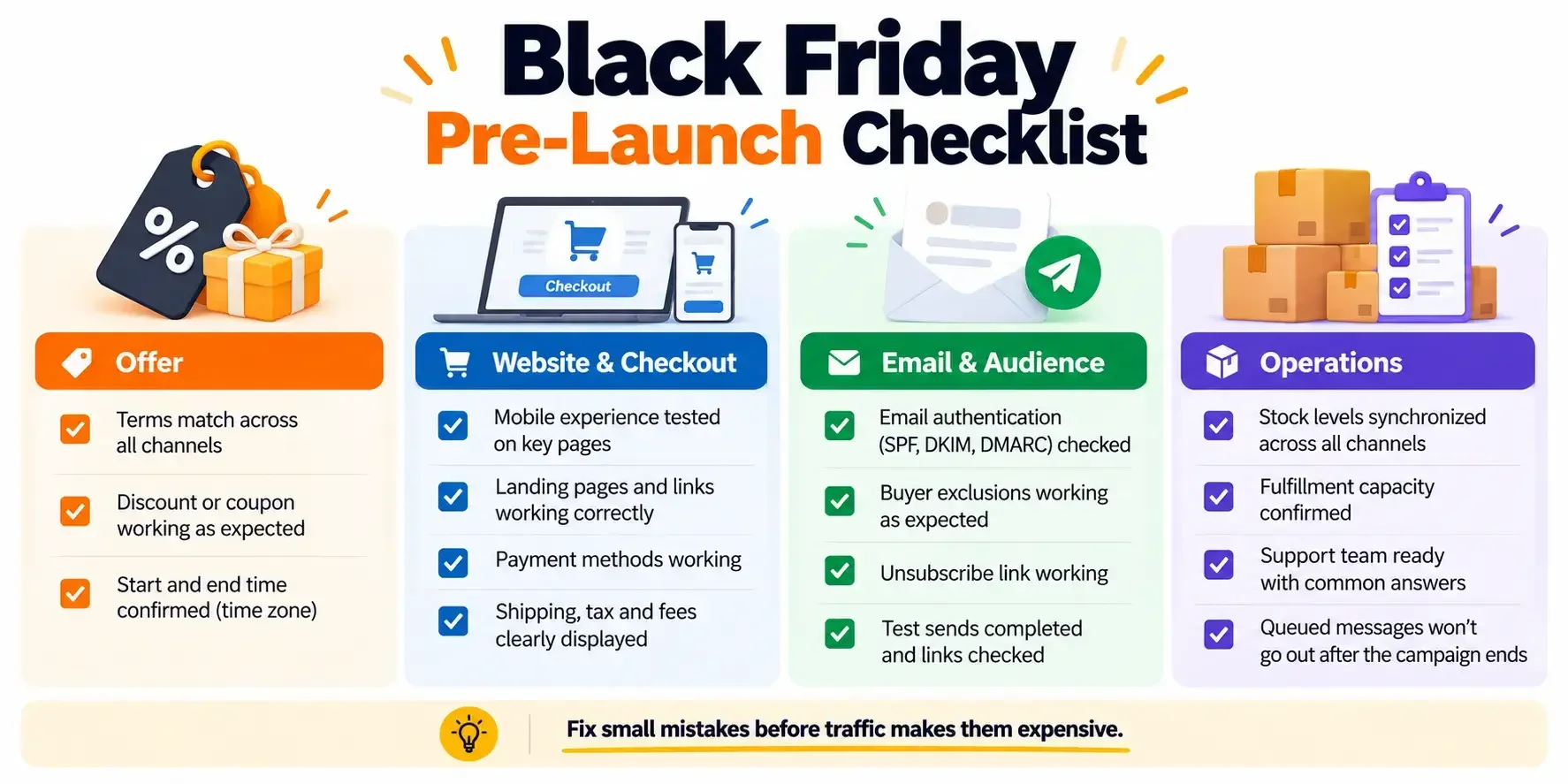
Before the campaign goes live, verify:
- offer terms match across every channel
- landing-page links work
- mobile checkout works
- coupon rules behave correctly
- shipping charges are clear
- payment methods succeed
- tax presentation is accurate
- stock is synchronized
- confirmation messages are correct
- support information is visible
- fulfillment capacity is realistic
- buyer exclusions work
- sale expiry is configured correctly
- queued messages cannot promote an expired offer
This is the last point where small campaign mistakes are cheap to fix.
Does an order mean the customer paid?
Not necessarily.
WooCommerce documents Pending payment as an order that has been received but is still awaiting payment. Processing generally means payment has been received and stock has been reduced, while other statuses cover failed, cancelled, completed, refunded, and other order states.
If an automation stops simply because an order record exists, an unpaid or failed order could be mistaken for a successful purchase. Use the order state that represents successful payment in your actual WooCommerce and gateway setup.
7. Put the Campaign on a Black Friday Timeline
A useful Black Friday calendar shows the purpose of each stage instead of forcing every customer to receive a message on every date.
Thanksgiving falls on November 26, 2026, making Black Friday November 27 and Cyber Monday November 30.
A practical 2026 campaign timeline
| Period | Main job | What to check |
| October | Cost the offer and prepare operations | Margin, inventory, checkout, sender setup |
| Early November | Build interest and optional early-access list | Promise, audience, content |
| Nov. 23–26 | Preview or genuine VIP access | Offer availability and correct links |
| Nov. 27 | Public Black Friday launch | Stock, terms, exclusions, payment path |
| Nov. 28–29 | Answer objections and send useful reminders | Buyer exclusions and inventory |
| Nov. 30 | Cyber Monday communication if appropriate | Real deadline and remaining capacity |
| Dec. 1 onward | Fulfillment, education, and review | Stop event-specific promotion |
A larger business may add SMS, push notifications, affiliates, creators, retargeting, or paid search. A smaller team may rely on email, a landing page, social content, and a limited paid campaign.
Practical Black Friday marketing strategies keep complexity aligned with capability and give every major action a clear date, audience, purpose, and deadline.
Is it too late to start Black Friday marketing?
If you are starting late, the campaign should become smaller rather than more frantic.
Prioritize:
- one viable offer
- one reliable landing page
- one clear launch message
- one useful reminder if needed
- correct buyer exclusions
- a real expiry process
Do not squeeze a month of teasers into four days just because another business started earlier.
How should you use urgency?
Use urgency customers can trust.
A real deadline, stock limit, or shipping cut-off can help someone decide. Repeatedly extending a supposedly final deadline weakens that signal.
If Cyber Monday uses different terms, plan them before Black Friday and consider how those terms will feel to customers who purchased earlier.
8. Measure Contribution and Keep New Buyers After the Sale
Effective Black Friday marketing strategies should be evaluated using paid orders, refunds, contribution, and customer outcomes alongside marketing attribution.
Once the promotion ends, buyers and nonbuyers should return to different communication paths.
What should buyers receive after Black Friday?
New customers may need:
- fulfillment updates
- setup guidance
- educational content
- customer support
- replenishment reminders
- genuinely relevant complementary products
A customer who bought the promoted item yesterday should not continue receiving messages telling them to buy it again.
What should you measure?
Use clear definitions before reviewing performance.
| Measure | Practical definition | What it tells you |
| Paid orders | Distinct qualifying paid orders | Valid order volume |
| Distinct buyers | Unique purchasing customers | Customer volume |
| Net merchandise revenue | Revenue after discounts and defined refunds | Realized sales |
| Campaign contribution | Net revenue minus defined variable and campaign costs | Economic result |
| Store conversion rate | Qualifying orders divided by eligible sessions | Store performance |
| Email recipient conversion | Purchasing recipients divided by eligible recipients | Audience performance |
| Repeat purchase rate | Event buyers who purchase again within a stated period | Retention |
Are you double-counting attributed revenue?
Suppose your email platform reports $20,000 in attributed revenue and your advertising platform reports $18,000.
That does not automatically mean the two channels produced $38,000 together. The same purchase may receive credit from more than one attribution model.
Reconcile channel reports against distinct store orders and use a defined refund window. Attributed revenue tells you which touchpoint a model credited. It does not prove that every credited sale was caused by that channel.
That brings the Black Friday Campaign Decision Framework full circle.
Economics → Audience → Timing → Eligibility → Measurement
9. Use WordPress Tools to Execute the Strategy
WordPress tools should execute your Black Friday plan after the offer, audience, timing, and customer rules have already been decided.
For teams using NextCRM, current documentation shows that campaigns can be created inside WordPress and automation workflows can use WordPress and WooCommerce events alongside actions, delays, and conditions. (NextCRM)
The platform also documents actions for sending email or SMS, changing tags and lists, updating contact information, cancelling an automation, and ending a funnel. (NextCRM)
Those building blocks can support the strategy in this guide, but important paths still need testing. Check purchase states, delayed messages, overlapping campaigns, unsubscribes, refunds, and sale expiry before relying on the workflow during a high-volume event.
Using WordPress for your campaign? Build the strategy first, then use NextCRM to organize contacts, campaigns, and automation rules around the customer states that matter.
Black Friday Marketing Strategy FAQs
Start early enough to calculate the offer, confirm inventory, prepare creative, test checkout, review email infrastructure, and coordinate fulfillment. If you begin late, simplify the campaign rather than compressing every earlier activity into a few days.
There is no universal best number. Give each email a specific job and account for other automations already reaching the same customer. Relevance and eligibility matter more than following a fixed send count.
Calculate what remains after product costs, payment fees, shipping, returns, gifts, and other variable expenses. Compare the result with bundles, gifts, exclusivity, thresholds, and other offer types before choosing a percentage.
A late campaign can still work if the plan matches the time available. Focus on one viable offer, a reliable purchase path, an eligible audience, clear communication, and accurate expiry rules instead of adding unfamiliar channels at the last minute.
Build a Black Friday Campaign You Can Defend After the Sale Ends
The strongest Black Friday marketing strategies are the ones you can explain not only while the sale is running, but also when you review the numbers afterward.
A good campaign does not need the deepest discount, the most emails, or the widest channel mix. It needs a financially sensible offer, a relevant audience, consistent terms, a buying experience that works, and clear rules for when promotional messages should stop.
Let economics define what the campaign can afford. Audience and eligibility should determine who receives each message, while timing keeps the campaign coordinated without relying on manufactured urgency. Finally, measurement shows whether the additional sales created enough contribution and whether those buyers became valuable customers afterward.
Black Friday success is not about doing more than everyone else. It is about making every offer, message, and deadline financially and operationally defensible.